
Loading cart contents...
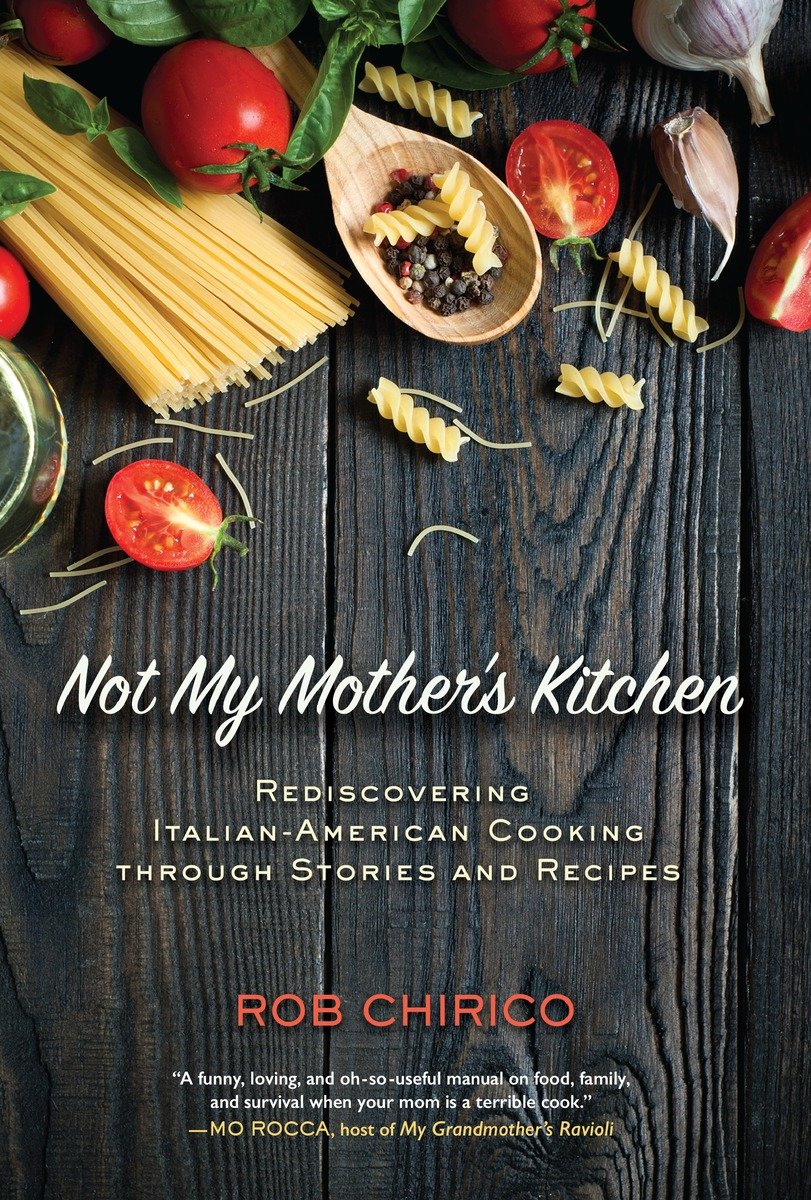
Not My Mother’s Kitchen: Rediscovering Italian-American Cooking Through Stories and Recipes
19.00 JOD
Please allow 2 – 5 weeks for delivery of this item
Add to Gift RegistryDescription
Mo Rocca, host of “My Grandmother’s Ravioli” says: “When life gives you lemons, make limoncello! Not My Mother’s Kitchen is a funny, loving, and oh so useful manual on food, family and survival when your mom is a terrible cook.”Serving up a tale that is part memoir and part cookbook, acclaimed foodie Rob Chirico shares his culinary journey after growing up with an Italian-American mother who was hopeless in the kitchen.Rob Chirico learned to cook as a defense against his mother’s awful meals. After discover-ing that there was more to real food than canned ravioli and frozen vegetables, he decided to try his hand in the kitchen. His memoir offers recipes, cooking techniques, and tips he has cultivated over decades. He blends his expert experience with an engaging and humorous narrative on growing up with suspect meals.”I was howling with laughter and shedding tears of nostalgia at the sensitive portraits of family and culture of the times.” — Linda Pelaccio, Culinary Historian and host of “A Taste of the Past” “… no mere cookbook. It is a personal story that lovingly and humorously describes the author’s culinary coming of age. It is a family’s history and it also is American cultural history…” — Michael Stern, author of Roadfood, Chili Nation, American Gourmet“A heartwarming story of growing up in an Italian-American household where there was no dearth of love, but not much in the way of good food. Thrown in for good measure are plenty of recipes, cook’s tips, and historical anecdotes. It’s a keeper.” —Julia della Croce, writer, journalist, and cookbook author
Additional information
| Weight | 0.5 kg |
|---|---|
| Dimensions | 2.29 × 15.75 × 23.63 cm |
| PubliCanadanadation City/Country | USA |
| Author(s) | |
| Format Old` | |
| Language | |
| Pages | 240 |
| Publisher | |
| Year Published | 2016-9-6 |
| Imprint | |
| ISBN 10 | 1623545013 |
| About The Author | Rob Chirico is a freelance writer, former art history professor at the New York Fashion Institute of Technology, and artist whose work has appeared in the food journal Gastronomica. He flipped burgers in college and won the Sutter Home Build a Better Burger Contest in 1991. Previous works include Field Guide to Cocktails (Quirk Books) and Damn!: A Cultural History of Swearing in Modern America (Pitchstone Press). Rob lives in western Massachusetts. |
Award-winning chef Chirico’s (Field Guide to Cocktails) humorous culinary memoir recounts his love of Italian food that developed as a reprisal against his mother’s dreadful cooking. Growing up in an affectionate Italian family, Chirico’s home life was filled with laughter and music, but his dinners often consisted of canned and frozen foods and perhaps some cold cuts from the local deli. His grandmother, however, was an accomplished cook, and as the author accompanied her to their local markets, he developed both an admiration for good cooking as well as the ability to discern the excellent vs. average characteristics of ingredients. Chirico shares more than 70 recipes, including soups, salads, pastas, meat dishes, and pizza. Each recipe is prefaced with an introduction that includes a family anecdote or compelling facts about a particular item. Most of the recipes are uncomplicated and include easy-to-find ingredients (for the occasional rare product, a mail-order source list is included). Appendixes feature the author’s favorite kitchen utensils as well as cookbooks he deems influential. Filled with nostalgic stories, delicious recipes, and a wealth of facts and tidbits about Italian food, this will appeal to readers who enjoy chef biographies.- Library Journal Chirico (Field Guide to Cocktails) delivers a title that is equal portions humorous memoir and cookbook, and totally entertaining. Comically referring to his mother as an assassin in the kitchen and to his quest to conquer the cuisine of his heritage as a measure of self-preservation, he shares his trials and tribulations from starting as a picky eater in a home where cooking didn’t exist to becoming a passionate cook and food professional. His love of Italian food was ignited during a trip to Italy, where he discovered how the locals truly ate. Recipes include long-simmered summer tomato sauce; spring risotto with gorgonzola, ramps, and cherry tomatoes; and cacio e pepe. Along with these Italian favorites, there are some atypical recipes such as baked stuffed tomatoes and lamb ragù. Chirico also provides historical and informative details on ingredients and recipe lineage. Approachable recipes and fun facts make this an entertaining read.- Publishers Weekly |
|
| Excerpt From Book | My mother was an assassin. This is a bold confession for a son to make, but it’s true. My mother was an assassin—in the kitchen that is. Now please don’t take this amiss. Outside of the kitchen she was one of the kindest, sweetest, and gentlest of people you could ever meet. As the writer Bill Bryson noted about his own mother, “When she dies she will go straight to heaven, but no one is going to say, ‘Oh, thank goodness you’re here. Can you fix us something to eat?’” I credit my love of books to my parents. Then there was music. Our home was filled with music—Broadway, jazz, Sinatra (of course), and even some opera. After all, we were Italian. But that was outside the kitchen. In front of the stove or at the microwave, my mother was the culinary equivalent of John Wilkes Booth. It has been alleged that Booth killed our country when he shot President Lincoln. My mother did the same to Italy. Martin Scorsese said, “If your mother cooks Italian food, why should you go to a restaurant?” Clearly, my mother never cooked for him. Growing up, my conception of Italian food didn’t differ much from that shared by most Americans. It was the food you were served in Italian restaurants: antipasto with olives and provolone, spaghetti and meatballs, veal Parmigiano, and lasagne with plenty of oozing mozzarella cheese. And yet, even before I ever stepped foot into a ristorante in Italy, the very word “restaurant” made me think of Italian food. That word evoked in me the pleasurable sensation I felt as I opened the doors and breathed in the aromas issuing from the restaurant kitchen. My sense of smell was so acute that my father once said that I had a “20-20 sniffer.” Mind you, this was not a compliment, as his remark was in reference to my clipping a clothespin to my nose to block out the odor of our Friday fish cakes. At the time, though, the more pleasant aromas beckoned me to eat, not to cook. So how does a boy go from growing up in a home where real food and a devotion to cooking were nonexistent to becoming someone who devotes considerable time every day to ruminating over the preparation and execution of every dish? I sometimes look back and wonder if my passion for good food was born out of self-defense: a defense against malformed, nearly cremated hamburgers; frozen and canned vegetables overcooked to the point that you could practically use a straw to ingest them; and, of course, so-called Italian food that was about as authentic as UFOs and Elvis sightings. But Cacio e Pepe (page 133) and Raw Summer Puttanesca (page 149) were a long way off. Self-defense or not, even as a picky little kid—who hadn’t the faintest idea that he would one day be editing cookbooks, become the winner in a national cooking competition, or spend nearly a decade working in a restaurant— I must have had an inkling that there was more to Italian cuisine than dumping Chef Boyardee Spaghetti and Meatballs into a pot. When I did begin to realize that there was more, I wanted to cook. It should have been simple. So many people did it. What I discovered over time was that there was much, much more to it than I had imagined. I’m sure I’m not alone in thinking that all I wanted to do was go into the kitchen and cook. Why did that prove so very difficult? Back in the early 1960s, our neighborhood of Jamaica, Queens, was a mix of Italian, Polish, Irish, and Greek families. On any given summer Saturday afternoon you could hear Sinatra, polkas, the Clancy Brothers, and bouzouki music streaming from different houses. By evening time, the aromas of home cooking began to fill the air. Mrs. Giorsos baked incredible butter cookies—which made up for the stench that filled the neighborhood when she was making her own lye soap. Mr. Berezowski had a special cache of horseradish that could singe your eyebrows if you just sniffed it. I loved it, and have since grown back a full pair of eyebrows. |
Only logged in customers who have purchased this product may leave a review.
Related products
-
![]()
On backorder 2-5 Weeks to Arrive
Add to Gift Registry10.99 JOD -
![]()
On backorder 2-5 Weeks to Arrive
Add to Gift Registry14.99 JOD -
![]()
On backorder 2-5 Weeks to Arrive
Add to Gift Registry25.00 JOD -
![]()
On backorder 2-5 Weeks to Arrive
Add to Gift Registry14.00 JOD



Reviews
There are no reviews yet.